Showing posts with label 1950s. Show all posts

Tuesday, July 12, 2016

I would like this: Rocky Jones, Space Ranger Tunic, 1954

Space Ranger Shoulder Patch

This jacket represents one of the only known pieces to have survived from Rocky Jones, Space Ranger, an important early TV program that aired April-July, 1954. The jacket's militaristic design was a huge influence on uniforms in later sci-fi series like Star Trek and Lost In Space.  (images via Hake's)

Rocky Jones, Space Ranger Tunic

Wednesday, April 6, 2016

If I Were A Rich Girl - The Hake's #217 Ring Collection Edition

So, Hake's Auction #217 came and went (March 15-17, 2016). 

Having seen so many tempting items it was hard to pick just one - and with finances as tight as they are, only one item would be allowed. In light of these factors this collector decided to sit #217 out. Below are the ring items on my list that had no bids - making the minimum bid sufficient to win. 

If I were a rich gal, all of them would be mine.

Without further delay I present the items no one bidding wanted - my island of misfit pop culture remnants would have been grand... (Click on the images to enlarge)

SECRET OPERATOR MELVIN PURVIS LAW AND ORDER PATROL RING - PLATED IN 18K GOLD
Premium ring from F.B.I. agent, on the scene for both killings of John Dillinger and Pretty Boy Floyd, turned radio host sponsored by Post's cereals. Brass with adjustable bands from 1937. Top has shield surrounding club logo. Professionally 18K gold plated to Mint luster. (link)

DICK TRACY GOOD LUCK SECRET COMPARTMENT RING
1938 Quaker premium in brass with adjustable bands. Sides show four leaf clover and horse shoe designs while top has rectangular compartment with removable brass lid. Lid has high relief portrait of Tracy surrounded by good luck symbols. (link)

SKY KING'S-FIRST PREMIUM RING WITH GLOW-IN-DARK TOP
Known as the 'Radar Signal' ring this 1946 premium has a brass base with adjustable bands with top holding rectangular plastic stone which glows a soft blue color after light exposure then darkness. This piece slides off to reveal a secret interior compartment. With the top removed, the ring top displays Sky King's Flying Crown logo. (link)

SUGAR JETS-CEREAL FOUR COMIC CHARACTER SCARCE RINGS
These were issued in 1964 by both Sugar Jets and Cracker Jack...This group includes 'Kayo' in both light blue and brown. Terry of Terry & The Pirates. And Smilin' Jack is in cream - my personal favorite of the set. (link)

SIXTEEN RINGS PLUS TWO DUPLICATES FROM THE 1960s-1980s
This is a miscellaneous group with numerous scarce rings. Begins with ring in thin brass showing Asian man with pigtail and mustache plus image of his hands holding a chain. Probably 1950s. Second is fierce face with oval mouth showing teeth and pair of tiny ball bearings beneath clear plastic eye covers. Marked on the underside 'Cleinman & Sons' and from the 1960s. Next is silver plastic base with paper label 'Go-Go-Bats.' Next is plastic 'Casper' the ghost. Next is Dennis The Menace and his dog Ruff from the 1960s (two of four in set). Next are Addams Family plastic figurals that fit on a prong on a plastic base. Next is scarce 1960s silver base with flasher top showing green face Frankenstein alternating to a red face Devil. Next is Spider-Man issued in 1975 by vitamin maker. Next are two rings from Battlestar Gallactica. Two different style metal bases but each has color circular top with one showing Daggit and the other an alien. These are from 1978. Next is a copyrighted 'Marvel' ring. A simple circular band in silver luster with alternating designs of "4" (for Fantastic Four) with an "X" in a circle for X-Men. Last is a large plastic Thundercats Ring from Burger King, 1986. (link) 

COUSIN EERIE PORTRAIT RING PLATED IN 18K GOLD
Ring is in heavy brass which the previous owner had professionally plated in 18K gold to a lustrous Mint appearance. Band is a single piece of metal that expands. Top is high relief portrait and underside has 1969 copyright of Warren Pub. Co., the publishers of Eerie Comics. (link)

CHICAGO CENTURY OF PROGRESS EIGHT DIFFERENT PLUS THREE DUPLICATE RINGS
These are all adjustable band silvered brass souvenir rings. Of the eight different rings, four are dated for 1933 and four for 1934. Most are silvered brass with second ring in row 2 in brass. Five of the eight include enameling. The final three rings in the photo are the duplicates. (link)

KING FEATURES EIGHT COMIC CHARACTER RINGS
These are from a 1953 set of 20 different and they were sold off of store cards holding 36 rings. Each has a plastic gold luster base with cream colored plastic figure of the character on top and characters have some single color accenting. This group consists of: Barney Google, Blondie, Hans, Inspector, Mama Katzenjammer, Maggie, Olive Oyl, Swee' Pea. (link)

"GREEN HORNET" FLICKER/FLASHER RING SET
Complete set of 12 plastic rings w/inset flicker/flasher pictures. 1966. Each features two different character or action scene images of Green Hornet, Kato, etc. This is the set w/original silver plastic bases marked "China." (link)

KELLOGG'S CORN FLAKES F-87 SUPER JET PLANE RING, MAILER & AD
Lot of four pieces, all from 1948...and offered via Pep cereal and on the Superman radio program. Canadian issue. First is ring w/adjustable brass band w/airplane image on each side. Top has metal spring-loaded black plastic airplane which shoots off ring top when lever is released. Comes w/original mailer box w/typed Canadian name/address label. Also comes w/folded as issued directions/order form w/some French text. "Jet Plane Ring" Sunday funnies ad shows image of ring w/image of Curtiss-Wright jet test pilot Lee Miller (who was also featured on instructions) and has coupon to order ring w/one Corn Flakes box top and 20¢. Corn Flakes cereal box is shown as well. Exc. Rare as complete and w/ad. Franco Toscanini Collection. (link)

Well there you have it. 'One man's junk'...blah, blah, blah... 

All images and descriptions are via Hake's Americana & Collectables.

Friday, January 29, 2016

The Sci-Fi Orbs As Imagined By Vargo Statten and René Brantonne

Les Fabricants de Soleil (The Sun Makers) 1952
English author Vargo Statten (aka John Russell Fearn) and French illustrator extraordinaire, René Brantonne teamed up a number of times during the 1950s and early 1960s creating works for the science fiction book series, Anticipation, published by Black River of France. Orbs of one kind or another figured prominently in Brantonne's cover art. Feast your eyes on these dandies from the 1950s.

La Planète Pétrifiée (The Petrified Planet) 1952
Course vers Pluton (Deadline To Pluto) 1953
Infernale Menace (English Edition: The Red Insects) 1953
A Travers les Ages (Across The Ages) 1954
Mystérieux Délai  (English Version: A Time Appointed) 1956
L'Homme Multiple (The Multi-Man) 1957

Sunday, December 20, 2015

They're Not Just 'Toy Robots'

In the 20th century nothing represented the spirit of the new technological age than the robot.  Robots were imagined as friends, helpers, liberators, and sometimes frightening rebels waiting for their chance to take control of Earth's destiny. Those images of the robot's role remain in the 20th century psyche, but the wonder isn't quite the same. Below are some examples of classic robot miniatures that rocked the imaginations of children and adults alike. And judging by the selling prices they're still immensely valuable to those who understand their place in modern history.

'1950's Japan Marubishi Co's Scarce Hook Robot - One of the most sought after of all 1950's tin plate Japanese Robots. Called "hook" Robot due to the Hook riveted on the head. Classic Skirted design with Block head. This robot has elegant yet Intricate litho details that inspire that most purist of robot collectors . This is the highly coveted light blue with silver mouth version . The arms roll freely at their sides While the friction power also causes the head to turn.' - Ozzie's Robot Toys & Collectibles

Sold At Auction: $1,900
'1950's Japan KO CO's Rare Spaceman with Rare Original Box - Nice working example of this desirable & rare 50's astronaut. Finished in a light blue & has a moving mouth that operates when the toy is in motion. Much more difficult to find than the red version. This version has nicer lithography details as well. Operates Via crank action.' - Ozzie's Robot Toys & Collectibles

Sold At Auction: $3,750

'1950's Japan Scarce !!!! Aoshin CO's Chime Trooper with Scarce Box- This is a super scarce piece that rarely surfaces. The chime trooper features wind up Bump & Go Action & a sound is also produced that many refer to as the "chime sound". Beautiful all tin lithography graces the classic skirted design. This toy is undoubtedly on the top of many high end collectors wish list..' - Ozzie's Robot Toys & Collectibles

Sold At Auction: $5,000

'1950s Friction Powered Space Adventure Robot with Incredibly Rare Original Box - Made by Yoshiya, Japan. - Clear plastic dome revealing a spinner beneath. This is a version of the coveted 'Space Trooper' distinctive because of its silver color. This is a rare robot that may have been a salesman's sample with a first design box. Certainly the name 'Space Adventure' is unique. Crank operated robot travels forward as the antenna inside the dome turns. Wheels in the base allow the robot to move but they are not eccentric and do not give the robot the waddling walk of the regular Space Trooper.' - Alphadrome Robot and Space Toy Database

Sold At Auction: $8,500

1950's Japan Scarce Deep Sea Robot with Ultra Scarce Original Box - Made by AHI, Japan. Extremely Rare Toy ( the rarest in this series ) & with ultra scarce original box. The Deep-Sea Robot carries an underwater gun and has neat 'piping' into his suit and helmet. There is reportedly only 2 or 3 of the Original boxes for this toy known to exist.

Sold At Auction: $9,500

1958 Scarce !!!! and Highly Desired Radicon Robot with Extremely Scarce Original Box - The first of Masudaya, Japan, 'Gang Of Five' series. The world's first radio remote controlled robot. Radicon has no litho and is instead finished in a steel gray textured finish giving him a true robot appearance. Torso is inset with an electric light and gauge. Controlled by a radio remote. The actions include moving forward & backward while also being able to turn. The eyes, mouth and ears light up. The copter on the left ear spins.

Sold At Auction: $31,000

And there it is: They're not just 'toy robots' - they're valuable artifacts of the 20th Century.

Friday, October 16, 2015

Read All About It: 'The Man From Planet X'


EXTRA! EXTRA! INVASION FROM SPACE - The Man from Planet X, 1951 (USA) promotional news sheet. (image via wrong side of the art)

Right click & choose view image for larger view.

If you have time for a movie, you can view The Man From Planet X below.


The Man from Planet X by MargaliMorwentari

Thursday, September 24, 2015

What Curiosity Can't Show Us About Mars

The cities are underground!


Original Cinecolor theatrical trailer for the 1951 Monogram Pictures' space adventure, FLIGHT TO MARS, starring Cameron Mitchell, Marguerite Chapman and Arthur Franz.

Sunday, September 13, 2015

Long Ago And Far Away - The Empire Strikes Back (1950)


A brilliant Premake trailer of The Empire Strikes Back (1950 from whoiseyevan on YouTube:
Let's turn back the clock, shall we? Back to a distant time in an alternate universe far, far away... The 50s! It was a simpler age of 3-D movies, and robots named Robby, Gort, and Tobor. A hidden gem of this period in cinema is a little film called "The Empire Strikes Back", the second chapter in a planned three-part epic science fiction trilogy. While the preceding and succeeding episodes were never actually produced due to budgetary constraints, "Empire" shines as an example of 1950s 3-D space opera. The re-release of this trailer coincides with the 60th anniversary of this amazing film.

Wednesday, September 2, 2015

The Seemingly Impossible Mission For Space Cadets In 1953

In 1953 Ralston foods began distribution of Space Patrol premium trading cards inspired by the popular 1950's TV and radio outer-space drama - one random card was included in every box of Wheat and Rice Chex. The complete set consists of 40 separate cards - needless to say, the collectors probably had to buy a whole lot of Chex cereals to get them all. But what good space cadet could resist trying? The collection came in three sub-sets - Space Heroes/Stars, Rockets/Jets and Weapons (it really should have been Rockets/Jets and Tech), and Planets. The three sub-sets are shown below - the full color illustrations are way cool. This full set auctioned at Hake's in May 2007 - the final winning bid was $4,437.62. It was the first complete set ever sold in Hake's 40 year history.  (Click on the images to enlarge)
Space Heroes/Stars
Rockets/Jets and 'Weapons'
Planets

Friday, August 28, 2015

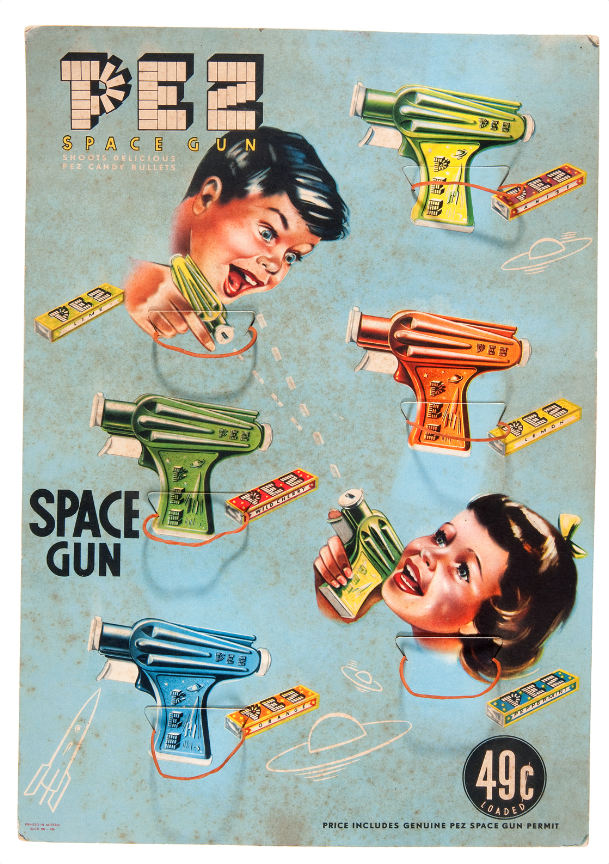
Do You Have A Permit For That Space Gun?

These came out in the 1950s - before they got space gunz off the streets.


Every Space Gun came with a permit which made it way too easy for felons to obtain the weapon.

Space Gunz were also fully automatic with easy to load cartridges - the number of PEZ rounds per minute was just crazy.

(images via Hake's)

Thursday, August 20, 2015

Imagining In 3D: Space Age Cool For Kids

It begins with a box:
The Explorer And Vanguard Tracking Station
Every smart space age kid knew that Explorer 1 was the first U.S. Earth satellite launched on 1 February 1958. It looked like this:

Image via NASA and the Jet Propulsion Laboratory (JPL) at the California Institute of Technology
Vanguard 1 was the second U.S. Earth satellite to achieve orbit - it was launched 17 March 1958. Vanguard 1 was the first solar powered satellite with six solar power cells attached. This satellite achieved a higher orbit than Explorer 1 and it remains as the oldest human artifact in space. It looks like this:

Image via Encyclopaedia Britannica
So now that you know what to look for, let's get a look at what's inside that box at the top of this post. The Structoys 1958 battery operated Explorer and Vanguard Tacking Station:

You'll first notice the 'radar scope' window - looking inside you'll see Earth which is lit by an eerie green glow when the station is in operation. Revolving around Earth are Explorer 1 and Vanguard 1. On the top left of the station is a rotating radar dish. The red and green lights below the dish on the console alternately blink on and off. On the top left of the console is a telegraph tower topped with a red beacon. Below the tower on the base of the console is a red metal 'code signal key' for Morse code telegraphy. A buzz can be heard as the code is tapped out on the signal key and the beacon atop the tower blinks. A red nob on the center of the base controls the on/off function of the unit.

The Tracking Station is a tin litho beauty with super graphics all the way around.

Tracking Station back view, top view, and left side view.
With a unit like this a kid's imagination could step out of internal space and right into the world of 3D -  creating a realism of imagination that could not only be seen and heard, but touched as well. And that's way cool.

The images in this post are via Grand Old Toys - this particular pristine, completely functional unit in the original box was sold online for $610.

H/T to Luis Cesar for reminding me about this fab space age toy.

Saturday, August 15, 2015

Flying Saucers Before UFOs - The 1950s Phenomenal Phenomenon


Roswell Daily Record, July 8, 1947, announcing the 'capture' of a 'flying saucer.'
When, on 8 July 1947, Roswell Army Air Field (RAAF) public information officer Walter Haut, issued a press release stating that personnel from the field's 509th Operations Group had recovered a 'flying disc' which had crashed on a ranch near Roswell, N.M., the press ran with it. Late that day the Commanding General of the Eighth Air Force, Roger Ramey, informed the press that what the RAAF personnel recovered was in fact debris from a 'weather balloon.' On 9 July 1947 the Roswell Record printed a statement by a local named William Brazel about debris that he had collected on a homestead north of Roswell. Brazell's description of the debris did not suggest a 'flying disc' of any kind - rubber that was 'smoky gray in color', 'tinfoil, paper, tape, and sticks', 'no sign of any metal in the area which might have been used for an engine, and no sign of any propellers of any kind, although at least one paper fin had been glued onto some of the tinfoil.'

As it turned out, CG Ramey wasn't entirely forthcoming with his explanation - the crashed device wasn't a weather balloon, it was a device that had been used in nuclear test monitoring.  Apparently the military did not want to disclose that bit of info. The Roswell flying disc story faded into obscurity until Stanton Friedman resurrected it in 1978. But that wasn't the end of the flying disc story - it would become a phenomenal part of 1950s culture. And strangely, one man would be there at every step.
FATE  Vol.1 Num.1 (1948)
FATE magazine's 1948 inaugural issue featured an article written by businessman and aviator Kenneth Arnold who recounted his experience of having seen nine 'saucer-like' objects flying in the sky near Mt. Rainer, Washington in 1947. Arnold's sighting is widely regarded as the spark of the modern UFO age. FATE's editor Ray Palmer is often referred to as 'the man who created the flying saucer.' More will be said about him at the end of this post. You can read Arnold's account here.
The Ether Ship Mystery and its Solution (1950)
Meade Layne's take on the emerging flying saucer phenomenon is interesting as he presents a different concept about their origins and their make up. Layne first off recognizes the variety of shapes and sizes in the descriptions of the craft - he doesn't emphasize the 'saucer' shape. Layne believed that the various craft materialize in this dimension from 'Etheria' (the etheric level). He refers to the inhabitants as 'Etherians'. Layne emphasizes his belief that the visitors and their craft do not come from outer space, Venus or Mars. This take was more ridiculed than the other theories that would become so popular in the 1950s. What is interesting is that this 'fringe' concept can be traced back hundreds of years in philosophy and science.
The Flying Saucers Are Real (1950)
Written by a U.S. Marine Corps naval pilot, The Flying Saucers Are Real is considered to be the first influential work on the subject of flying saucers and the extraterrestrial connection. Keyhoe presents a thoroughly researched look at various encounters with strange sky craft and USAF fighters and personnel, as well as other aircraft, between 1947 and 1950. He concludes that the U.S. Air Force had been actively involved with investigating these encounters and continued to do so, perhaps even obtaining alien technology. Keyhoe was convinced that the U.S. government was suppressing this research and info and believed that the government would release the information once the Soviet Union was no longer a threat.
Behind The Flying Saucers (1950)
Journalist Frank Scully's only book about the flying saucer controversy. In 1952 and again in 1956 True magazine exposed Skully's two informants/sources as hoaxters who duped the author. On a curious note, Scully was bestowed the special honor of Knight of the Pontifical Order of St. Gregory the Great in 1956 - The motto of the Order of St. Gregory the Great is Pro Deo et Principe (For God and Ruler).

The Riddle of the Flying Saucers: is another World watching? (1950)
Gerald Heard proposes that the flying saucers are vehicles for a super-intelligent, advanced, benevolent, tiny-in-size, bee-like species from Mars. The primary reason for Earth visitation is their concern that Earth, with the violence and atomic weapons, may be a threat to the galaxy.

Flying Saucers from outer space (1953)
Earth vs. the Flying Saucers, aka Invasion of the Flying Saucers was a 1956 film inspired by Major Keyhoe's descriptions and reports in this book.
Fate Magazine (1953)
FATE magazine celebrates five years with a special saucer issue.

WEIRD SCIENCE-FANTASY #26 (Dec. 1954)
EC comics' departure from the usual science fiction fare with a special issue in which editors Al Feldstein and Bill Gaines present a 36 page Flying Saucer Report with twenty-two 'incidents based on true stories.' Their challenge to the U.S. Air Force: answer truthfully a list of seventeen questions about the incidents that are based on reported facts. A photocopy of the article UFOs Over Washington, D.C. was placed in an Air Force records file and is now part of the National Archives.

Aboard A Flying Saucer (1954)
Truman Bethurum's exposé about his multiple experiences aboard a flying saucer in the Nevada desert and his conversations with the sexy captain named, Aura Rhanes. According to Bethurum Captain Rahnes and her crew come from a perfect planet called Clarion blocked from our vision as it is beyond the far side of the sun. Clarionites are Christian but parts of the population are turning towards paganism. They like square dances and polkas, the children are all very well behaved and organizational. There is no need for medicine, government, or laborers. Berthurum's wife gets a bit jealous and files for divorce naming Captain Rahnes in the proceedings. The Captain offers to take Bethurum to Clarion. She never answers their prearranged signals in the desert. Berthurum leaves Nevada and returns to his native California. He went on to write three more books and establish 'The Sanctuary of Thought' in Arizona.
Space, Gravity & The Flying Saucer (1955)
British aerospace engineer Leonard G. Cramp's classic discussing the theoretical necessities for flying saucer interstellar propulsion. He also discusses suppressed technology. Technical and scientific.
Flying Saucer From Mars (1955)
Cedric Allingham relates his experience when, while vacationing in Scotland, he witnessed the landing of a 50-ft flying saucer and proceeded to have a conversation - of sorts - with a tall Martian who emerged from the vehicle. The British UFO community got very excited about it all. Problem is, Cedric Allingham didn't exist. When the man never appeared in public (except once) questions began to arise. Turns out that the book was a rewrite by an Englishman named Peter Davies. Davies admitted that he was asked by the original author to disguise his signature by rewriting the tale in his own voice. After extensive research into the mystery, British UFOlogists Christopher Allan and Steuart Campbell concluded that the original author was an amateur astronomer and known flying saucer skeptic named Patrick Moore. Moore vehemently denied this accusation and went on to become a popular television and radio personality and was knighted by the Crown. Those who believe Moore was indeed the author of the tale are perplexed as to Moore's motives in doing so. Patrick Moore died in 2012 never admitting that he was the author of the 'hoax'.

They Knew Too Much About Flying Saucers (1956)
The book that introduced the Men In Black into the flying saucer culture. (M.I.B. - the mysterious men in black suits driving a big black car that intimidate alien phenomenon witnesses into silence.) Author Gray Barker used the funds made from this book to start Saucerian Publications. He became a well known writer and publisher in the field. After Barker's death, author and newspaper editor John C. Sherman wrote an article for The Skeptical Inquirer in which he portrayed Gray Barker as a money hungry fraud - the article is titled, Gray Baker: My Friend, the Myth-Maker.

Flying Saucers Fact Or Fiction? (1957)
Twelve Year Research of U.F.O.'s in Our Skies Revealed by the Top Scientists, Astronomers, Airforce Personnel, and Technical Observers. Author Max B. Miller founded Flying Saucers International in 1952 which still exists as a 'non-profit investigation unit, researching all facets of Unidentified Flying Saucers.' Note the acronym U.F.O. - it would be used more frequently as the 1950s faded as a decade.

Amazing Stories  (October 1957)

Amazing Stories special issue that contains a supplement dealing with 'UFO, commonly called Flying Saucers.' The editors allow free hand to the writers, all of whom have a reputation in the conversation as either believers or skeptics, so that they may represent their viewpoints to the reader. The reader then has a 'broad foundation' with which to make their own opinion.

Flying Saucer Pilgrimage (1957)
'The Story of An Amazing Private Research which took Two Year's Time and Over 23,000 Miles of Travel.' The Reeves began their pilgrimage for the truth about the flying saucer phenomenon by going out to meet some of the more well known witnesses. By chapter fifteen they decide that 'flying saucers themselves per sé are no longer of prime importance . . . it is not physical saucers that are the important thing but what lies behind the physical aspects.' The book then goes into an exploration of the 'supra-physical' or metaphysical meaning behind the experiences. It was after the Reeves met Meade Layne that they took this new approach.

You'll notice that the cover features a craft with quite a different design than the saucer-like design so popular on the other covers. This shape had been used to describe the strange craft by some witnesses for years. This harkens back to Layne's The Ether Ship Mystery in 1950. The idea of the 'flying saucer' was now being transformed - the golden age of the 'saucerian' was fading away.

Another interesting aspect to this is that the Reeve's book was published by Amherst Press - a Ray Palmer publishing house. The same Ray Palmer mentioned at the top of this post. The same Ray Palmer who published Kenneth Arnold's account in FATE magazine in 1947. The same Ray Palmer who published this issue of Flying Saucers in the same year as the Reeve's book - 1957:

Flying Saucers (1957)
Flying Saucers and the U.S.Air Force (1960)
Lt. Lawrence J. Tacker, U.S.A.F., is credited as the author of this 'Official Air Force story.' At the time, Lt. Col. Tacker was the official spokesman for the Air Force on the subject of UFOs. The book is presented as the story of the 'long investigations' carefully conducted by the Air Force for 'each sighting' and their findings. The vast majority of cases are given mundane, and sometimes ridiculous, explanations. Some are acknowledged as unexplained. A number of researchers consider this book to be a kind of Air Force answer to Donald Keyhoe's public success with putting the focus on the Air Force when discussing the flying saucer phenomenon.

The official Air Force story was published in 1960. It was the beginning of a new decade and a new approach to strange sky craft. They would commonly be referred to as Unidentified Flying Objects - UFOs. In a strange sort of way, we come full circle. In 1950 Meade Layne emphasized the diversity of the mysterious sky craft. He also presented the idea that the visitors weren't from 'outer space', but more probably from the space we consider empty - but it's not - 'etheric' space. It all would take a more meta-physical turn.

Flying Saucers (Nov 1963)
Publisher/Writer Ray Palmer had his hand in some of the most curious stories of flying saucer occurrences for years. He started as a very successful editor for Amazing Stories from 1938-1949. Palmer had a very big hand in the strange Shaver Mystery controversy that took hold of Amazing Stories from 1945-48. He went on to edit Fate magazine. It was his influence that drew Kenneth Arnold back into the public eye after Arnold thought of leaving his story behind because of the controversial aspects of his report and the ridicule. Through the years, Palmer worked as editor for a number of other magazines and books through his own publishing houses, including Amherst Press and Palmer Publications. A few of the books mentioned in this post were published by Palmer publishing houses.

One of Ray Palmer's pet projects was Flying Saucers magazine first published in 1957 as Flying Saucers from Other Worlds. It's sort of fitting to end this Flying Saucer post with another of Mr. Palmer's interesting links. The above issue of Palmer's Flying Saucers features an article written by a 16-year-old named Gregory Swofford of Milwaukee, Wisconsin - The Swofford UFO Detector. In that article the young Swofford coined a new term, 'ufology.' Palmer, 'the man who invented the Flying Saucer', managed to associate his name into the new era of UFOs. Kind of remarkable.

So, we leave this subject with a little update. The scorpion-like object in the photo below was sent to the UFO Global Reporting Center by an individual named Jamie O'Rourke. O'Rourke reported that he saw this object in the sky over Los Cristianos, Spain on Saturday, August 21, 2011. The sky craft may have changed, but the commentary between skeptics and believers hasn't.