Is it a lost art? The May 1915 issue of Popular Mechanics magazine has a neat how-to article that provides the details for making a 'combined kite.' If you're a handy-crafty-mechanically-inclined sort, it looks like a cool project that could really impress family, friends, and neighbors. The article can be found here.
I found the Dragon Kite description and illustration of the the kite-head kind of cool:
The dragon's head and face look more like a kooky-type space traveler than something fiercely hideous, but that's just fine. According to the instructions the eyes are designed to revolve in their sockets - woohoo!
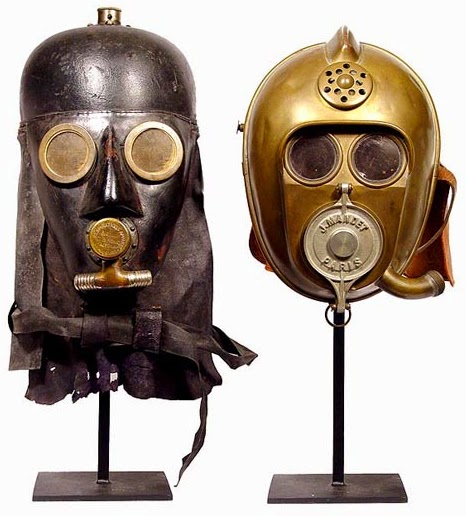
Early rescue masks c. mid-1800s to WWI (Photo via Steve Erenberg)
This pair of early rescue masks, shown above, dates from between the mid-1800s and World War I. They look a bit familiar, right? Almost 100 years before Darth Vader and C-3PO hit the big screen in “Star Wars” in 1977, these two smoke helmets were worn by firefighters carrying out rescues in smoke-logged buildings. The buzz among collectors is that George Lucas’s designers must have found inspiration in these smoke helmets and others like them. In fact, one well-known 19th-century manufacturer was named Vajen-Bader—you could easily get the name Vader from that.
The black leather helmet on the left is labeled “Respirations Apparat” by “G.B.Konic Altona,” was made in Hamburg, Germany, and has the look of an African Dan mask. The brass, three-quarter face mask to its right was made in Paris by J. Mandet. This type of breathing mask had a very simple apparatus, allowing only a short range of operation. When used, air would be forced into the helmet through no more than 13 meters of flexible tubing by means of a bellows operated remotely from the outside. Both of these masks have mica lenses to help protect the eyes from heat.
Okay, the inspiration is obvious. But think about it - imagine crawling on the floor of a smoke-filled apartment or house, trying to feel your way out to safety and then, your eyes trace a figure standing in front of you reaching out. You look up and see...
Future Rocket Train, H. W. McCauley - Amazing Stories, January 1939 (Back Cover)
A floating rocket train - excited about the magnetic properties of cobalt steel, the folks at Amazing Stories envisioned the possibility of this futuristic mode of transportation. Note the streamlined auto designs and the Art Deco style of the building on the lower left - all part of the fascinating design culture of the 1930s.
Cool or what? A Creature iron-on from 1965. Check out Karswell's post at and everything else too to see all six classic movie monster iron-ons offered in an advert from Victor Specialties back in 1966. Wolf Man's a star. Click here.
The iconic Burroughs B205 computer control console.
The B205 was first introduced in 1956 and was considered one of the industry leaders in computer science.
The flashing lights, shiny knobs, and toggle switches on the control console made it ideal for 1960s era sci-fi films and television programs. Most notably in the television series, Lost In Space, beginning in 1965:
The flight controls for the Jupiter 2 - the Burroughs B205 figure prominently on deck.
The B205 was also the favorite control console in Batman, the original television series beginning in 1966.
Robin does something at the Navigational Aid Computer - the B205 looks busy as well.
The B205 was multifunctional in Batman - here it's used as the Voice-Control Batmobile Relay-Circuit
Before the Burroughs B205 debuted in the Lost In Space television series it appeared in the 1959 sci-fi horror/adventure film, The Angry Red Planet.
Here the B205 slumbers aboard the M-1 spaceship surrounded by the crew of the first mission to Mars.
The Burroughs B205 was also used as one of a time machine's main control consoles in the 1964 sci-fi action/romance film, Time Travelers.
Overeager Steve Connors (Philip Carey) prepares for countdown to a time machine test with the B204 at his fingertips.
Burroughs' B205 system was designed specifically to cope with the full range of electronic computing problems in the fields of business industry, science and government.
The Burroughs B205 business office set up.
The B205 employed for use by the United Gas Corporation
The researchers and developers at the U.S. Naval Ordnance Laboratory in Corona, CA also utilized the B205 in their work.
So there you have it - the Burroughs B205 command console as film and television star. There were more appearances for this computer icon which also included the just as recognizable B205 tape drive. The Burroughs' design seemed to encapsulate the general vision of the computerized future at the time. While in reality it may have turned out a whole lot different, the B205 inspired generations of creative and curious people to pursue serious careers in computer science.
Life in 2062 when folks are living the high life - literally. Nearly every student of the future knows that when it comes to that whimsical techno-utopian age to be, the family to watch are the Jetsons. Even television itself stepped into the future when The Jetsons hit prime time on ABC-TV as the first program ever broadcast in color in 1962.
Now, getting to the high life. The family Jetson reside in Orbit City. Orbit City has all the accommodations you'd expect in a cosmopolitan sort of place - but they're all raised high above the ground. The architecture designs echo mid-20th century space age mod Googie style: sweeping arches and upswept roofs, large domes, boomerang, amoeba, and palette shapes, atomic symbols and motifs, flying saucer shapes, and of course, the starburst.
Below is a selection of images that highlight the man-made environs of Orbit City.
The Jetsons live in the Skypad Apartments - a large five story multiple-family dwelling.
George and Jane's son Elroy attends Little Dipper School (Note the boomerang-style platform).
Daughter Judy Attends Orbit High - complete with a large domed stadium.
Jane 'his wife' often spends her mornings at Orbit City's massive Shopping Center (Note the tiny people on the platforms, and the starburst array on the front-most structure, as well as the palette shaped sign).
George works as a 'digital index operator' at Spacely Space Sprockets, Inc. (Note the elevated drive/walkways that lead to the main entrance).
After daily activities there's always somewhere to hang out during the evenings:
The teens can hang out at The Spaceburger Drive-In (Note the electric rays emitting from the neon sign).
There's the space age Fun Pad amusement park for folks of all ages. (Note again the large size of this structure and rides by the size of the people on the platforms).
But the Jetsons also have getaways from their fair city:
The Moon is always an adventure and the Moonhattan Tilton Hotel is a popular resort. (Notice the tube travel system and the glass dome providing the comfy environment for visitors.)
When Jane and George decide on a second honeymoon, Las Venus is their choice. It's a super getaway spot for the couple and as with the Las Vegas of the 50s it has its share of temptations:
The Sonic Sahara Hotel and Resort is pretty swank in pink.
The Supersonic Sands Resort and Casino provides great accommodations. (Note the amoeba-shaped platform and the boomerang-styled swimming pool).
The Super Sonic Club is a stylish affair for dine and dancing. (Note the spaceship-style top structure and the zig-zag support beams underneath).
Back in Orbit City, a look at the structures that house the media:
Local station KLMN with a simple satellite array and the googie-style shaped backgrounds for the station call letters signage.
The asteroid TV Productions' structure features the large plate glass windows so popular in mid-mod architecture design.
Space Gems is a large complex with a more elaborate communications array for coverage to a larger audience.
Here are just a couple other residences away from the metropolitan area of Orbit City:
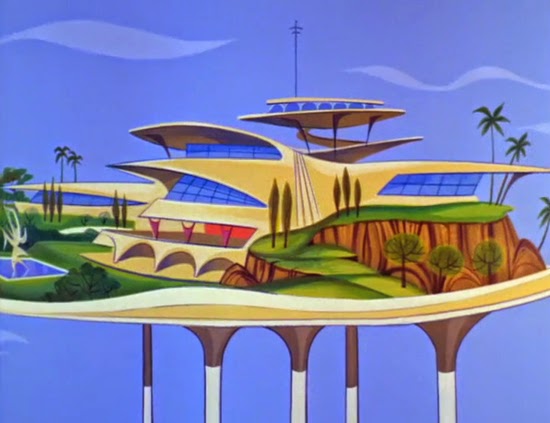
This is George Jetson's boss Mr. Spacely's 'old cabin' getaway - a very mid-mod styled vacation home of the 20th century (Note the sloping roof, the rosewood material for an added warmth to the design, and the stone chimney for a natural touch).
This is the sprawling ranch mansion of billionaire J.P. Gottorockets (Note the pond on the left with the abstract sculpture in the middle).
And finally, below are a few shots of life on the ground. Paradoxically, two of them are things you'd most associate with the sky:
The Grand Central Space-tion - interestingly this design is very much like that of the TWA terminal at the JFK airport in New York, designed by Eero Saarinen. Both were debuted in 1962 - coincidence?
In the seventh episode this little bird found himself grounded due to all of the traffic in the air.
The final image brings us all down to reality. At the lower levels of Orbit City reside the poor. The 'hobos and the layabouts.' In The Jetsons' seventh episode the character pictured below steps in briefly to give a punchline for a joke. Perhaps Hanna-Barbera meant this a a dark punchline in a general way as well - even with all the amazing gadgets and gizmos of 2062 poverty will still be with us. But while those who have are living the high life, those who have not (for whatever reasons) will be below out of sight and out of mind.
The Googie style began in Southern California in 1949 when designer John Lautner created the new look for Googie's coffee shop at the corner of Sunset Boulevard and Crescent Heights in Los Angeles. The style caught on and was soon used in designs everywhere. Where it really stood out were the gas stations and motels developed along American highways - Googie represented the Space Age and all of its promises realized in a visible way, it captured the imaginations of the new travel culture that developed post-WWII. The more conservative and pretentious architects and designers had - and have - ridiculed the designs complaining that they were garish and too vernacular to be taken seriously. The style faded after about twenty-five years. Much of the structures and signage have been dismantled and destroyed. There are groups of people who have begun to appeal for the preservation of those places that still exist - they point out that these are important visual reminders of an important era in U.S. history.
If you'd like to see and read more about Googie be sure to visit Googie Architecture Online - it's a marvy site and a great reference.




.jpg)