This jacket represents one of the only known pieces to have
survived from Rocky Jones, Space Ranger, an important early TV program
that aired April-July, 1954. The jacket's militaristic design was a huge
influence on uniforms in later sci-fi series like Star Trek and Lost In Space. (images via Hake's)
A complete 75 piece Captain Video Superior Space Port by T. Cohn, Inc.!
This might seem like advertising, but it's not. It's really just a big Neato!
Captain Video and His Video Rangers was a ground breaking sci-fi space adventure television series that aired between June 1949 and April 1955 on the American DuMont Television Network. The Captain was the first action hero specifically invented for TV and the show was the first regularly scheduled space drama on television. As with all things popular in pop culture, Captain Video was soon popping up in media outside the box. Fawcett Comics published a six issue comic book series in 1951, and Columbia Pictures produced a movie serial, Captain Video: Master of the Stratosphere, the same year. Admirers of the show could join the Video Rangers Club and buy stuffs like games, records, rockets, and helmets. Sponsors of the show offered mail-in premiums or free items in cereal boxes like rings, decoders, and small flashlights - all the items had cool special functions. And they are all treasures in today's collectors market.
This Captain Video Secret Seal Ring has a Buy Now price of $249.99 at eBay
This Captain Video Mysto-Coder decoder has a 36% markdown Buy Now price of $95.97 on eBay
The seller claims that this is the highest graded copy - A 9.0 Very Fine/Near Mint Fawcett Comics Feb. 1941 Captain Video issue #1. The Buy Now price is $1,385.00 on eBay.
Now, getting back to the T. Cohn Captain Video Superior Space Port. In her 2012 book, 1950s "Rocketman" TV Series and Their Fans, Cynthia J. Miller wrote this:
The set now up for grabs at eBay is listed at the heavy duty fun shop. It's run by Tom Frey - the author of the highly acclaimed 1994 book, Toy Bop: Kid Classics of the 50's & 60's.
As Toy Bop was coming together, one of its two largest sections became, space toys. In it, I wanted to include the most exciting and dazzling toys I could beg, borrow or buy. The Superior Space Port by T. Cohn was a toy that became a welcomed photo included in the book. Since then the playset has been safely tucked away over 20 years until now...This is a complete 75 piece set in near mint unused condition except for setting up for photos. First Toy Bop, then for this eBay ad.
Helmets, Rangers, Rockets, and Launcher
Robots and Interplanetary Space Men
Atomic Space Cannon
Captain Video Stamped Space Vehicles
Tin Lithographed Ground Level Space Drome
Nine spectacularly lithographed tin walls depicting a futuristic city...
The Mechanical Features: The Rotating Radar Screen and Controls in the Upper Tower, The Wind-Up Space Alarm, The Atomic Cannon, The Space Ship Launcher and Two Burgundy Space Ships, and a Rocket Launcher with Three Rockets
Back in the day, the complete T. Cohn Superior Space Port sold for $5.39. This particular set's Buy Now price is $1,250.00. Tom Frey: This dazzling Superior Space Port is recommended for adult collectors to display rather than any age children to play with. Museum Quality indeed - you can even find one in the Smithsonian National Air and Space Museum on display in the James S. McDonnell Space Hangar at the Steven F. Udvar-Hazy Center, Chantilly, VA.
The Man from U.N.C.L.E. (NBC TV, September 1964 - January 1968)
U.S. Operative Napoleon Solo and Russian Illya Kuryakin participate in a joint mission working for U.N.C.L.E. (United Network Command for Law and Enforcement). They battle a mysterious international syndicate known as THRUSH (Technical Hierarchy for the Removal of Undesirables and the Subjugation of Humanity), which is working to proliferate nuclear weapons.
That's the set-up. Below is a screenshot of Solo during a tense moment in The Iowa Suba Affair episode. He's holding the much coveted U.N.C.L.E. GUN - in this shot it's a Mauser carbine.
Cut to a close-up of the weapon - it's a Walther P38 carbine...!(?)
That's a neat bit of trivia pointed out by Brad Ferguson - the master craftsman at U.N.C.L.E. GUNS, the go to place for fab replicas. Like this P38 carbine:
It could be the real thing, yeah? If a collector wants one it'll cost a nice chunk-a-change. The all metal semi-auto blank gun (which fires 8mm blanks) alone sells for $575.00 - that's not including all the extras that make it the carbine version. Still, for a super-agent U.N.C.L.E. collector, the price is reasonable for this fab work of craftsmanship.
And then there's this...
It's the 1965 Man From U.N.C.L.E. Napoleon Solo Gun set! The toy weapon was designed by Reuben Klamer, and his staff at Toylab studios and marketed by Ideal. Rather than being based on the Walther P38 or the Mauser, this gun appears to be more of a standard .45 automatic. This kit has it all - the cap gun that 'Converts Into Rifle With: Stock, Silencer, Telescopic Sight, [and] Bipod' and it comes with an U.N.C.L.E. No. 6 plastic badge and a 'United Network Command For Law And Enforcement' membership card. Below is the listing from a 1960s Wards' catalog. Their version came with a holster. Notice the price.
The instruction sheet gives details on how to lock and load the caps clip, and the cleaning of the gun. Of course there's a nice detailed accessory assembly graphic as well.
The Wards' price was listed at $3.99. This particular set sold in most stores for $4.99. In March 2015, the final bid for the set at Hake's Auction #214 was $1,075.25.
So there it is. The moral of the story: Cold War weapons, real or imagined, are pretty damned expensive.
The iconic Burroughs B205 computer control console.
The B205 was first introduced in 1956 and was considered one of the industry leaders in computer science.
The flashing lights, shiny knobs, and toggle switches on the control console made it ideal for 1960s era sci-fi films and television programs. Most notably in the television series, Lost In Space, beginning in 1965:
The flight controls for the Jupiter 2 - the Burroughs B205 figure prominently on deck.
The B205 was also the favorite control console in Batman, the original television series beginning in 1966.
Robin does something at the Navigational Aid Computer - the B205 looks busy as well.
The B205 was multifunctional in Batman - here it's used as the Voice-Control Batmobile Relay-Circuit
Before the Burroughs B205 debuted in the Lost In Space television series it appeared in the 1959 sci-fi horror/adventure film, The Angry Red Planet.
Here the B205 slumbers aboard the M-1 spaceship surrounded by the crew of the first mission to Mars.
The Burroughs B205 was also used as one of a time machine's main control consoles in the 1964 sci-fi action/romance film, Time Travelers.
Overeager Steve Connors (Philip Carey) prepares for countdown to a time machine test with the B204 at his fingertips.
Burroughs' B205 system was designed specifically to cope with the full range of electronic computing problems in the fields of business industry, science and government.
The Burroughs B205 business office set up.
The B205 employed for use by the United Gas Corporation
The researchers and developers at the U.S. Naval Ordnance Laboratory in Corona, CA also utilized the B205 in their work.
So there you have it - the Burroughs B205 command console as film and television star. There were more appearances for this computer icon which also included the just as recognizable B205 tape drive. The Burroughs' design seemed to encapsulate the general vision of the computerized future at the time. While in reality it may have turned out a whole lot different, the B205 inspired generations of creative and curious people to pursue serious careers in computer science.
Life in 2062 when folks are living the high life - literally. Nearly every student of the future knows that when it comes to that whimsical techno-utopian age to be, the family to watch are the Jetsons. Even television itself stepped into the future when The Jetsons hit prime time on ABC-TV as the first program ever broadcast in color in 1962.
Now, getting to the high life. The family Jetson reside in Orbit City. Orbit City has all the accommodations you'd expect in a cosmopolitan sort of place - but they're all raised high above the ground. The architecture designs echo mid-20th century space age mod Googie style: sweeping arches and upswept roofs, large domes, boomerang, amoeba, and palette shapes, atomic symbols and motifs, flying saucer shapes, and of course, the starburst.
Below is a selection of images that highlight the man-made environs of Orbit City.
The Jetsons live in the Skypad Apartments - a large five story multiple-family dwelling.
George and Jane's son Elroy attends Little Dipper School (Note the boomerang-style platform).
Daughter Judy Attends Orbit High - complete with a large domed stadium.
Jane 'his wife' often spends her mornings at Orbit City's massive Shopping Center (Note the tiny people on the platforms, and the starburst array on the front-most structure, as well as the palette shaped sign).
George works as a 'digital index operator' at Spacely Space Sprockets, Inc. (Note the elevated drive/walkways that lead to the main entrance).
After daily activities there's always somewhere to hang out during the evenings:
The teens can hang out at The Spaceburger Drive-In (Note the electric rays emitting from the neon sign).
There's the space age Fun Pad amusement park for folks of all ages. (Note again the large size of this structure and rides by the size of the people on the platforms).
But the Jetsons also have getaways from their fair city:
The Moon is always an adventure and the Moonhattan Tilton Hotel is a popular resort. (Notice the tube travel system and the glass dome providing the comfy environment for visitors.)
When Jane and George decide on a second honeymoon, Las Venus is their choice. It's a super getaway spot for the couple and as with the Las Vegas of the 50s it has its share of temptations:
The Sonic Sahara Hotel and Resort is pretty swank in pink.
The Supersonic Sands Resort and Casino provides great accommodations. (Note the amoeba-shaped platform and the boomerang-styled swimming pool).
The Super Sonic Club is a stylish affair for dine and dancing. (Note the spaceship-style top structure and the zig-zag support beams underneath).
Back in Orbit City, a look at the structures that house the media:
Local station KLMN with a simple satellite array and the googie-style shaped backgrounds for the station call letters signage.
The asteroid TV Productions' structure features the large plate glass windows so popular in mid-mod architecture design.
Space Gems is a large complex with a more elaborate communications array for coverage to a larger audience.
Here are just a couple other residences away from the metropolitan area of Orbit City:
This is George Jetson's boss Mr. Spacely's 'old cabin' getaway - a very mid-mod styled vacation home of the 20th century (Note the sloping roof, the rosewood material for an added warmth to the design, and the stone chimney for a natural touch).
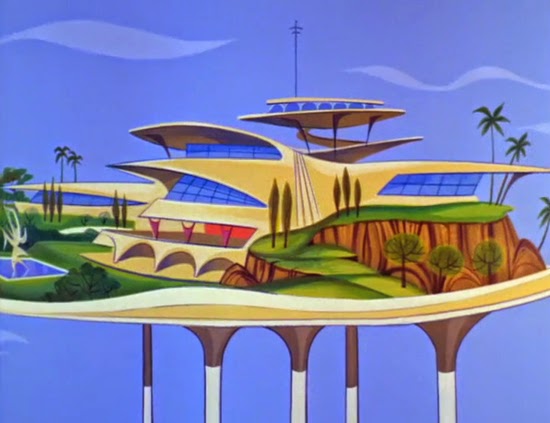
This is the sprawling ranch mansion of billionaire J.P. Gottorockets (Note the pond on the left with the abstract sculpture in the middle).
And finally, below are a few shots of life on the ground. Paradoxically, two of them are things you'd most associate with the sky:
The Grand Central Space-tion - interestingly this design is very much like that of the TWA terminal at the JFK airport in New York, designed by Eero Saarinen. Both were debuted in 1962 - coincidence?
In the seventh episode this little bird found himself grounded due to all of the traffic in the air.
The final image brings us all down to reality. At the lower levels of Orbit City reside the poor. The 'hobos and the layabouts.' In The Jetsons' seventh episode the character pictured below steps in briefly to give a punchline for a joke. Perhaps Hanna-Barbera meant this a a dark punchline in a general way as well - even with all the amazing gadgets and gizmos of 2062 poverty will still be with us. But while those who have are living the high life, those who have not (for whatever reasons) will be below out of sight and out of mind.
The Googie style began in Southern California in 1949 when designer John Lautner created the new look for Googie's coffee shop at the corner of Sunset Boulevard and Crescent Heights in Los Angeles. The style caught on and was soon used in designs everywhere. Where it really stood out were the gas stations and motels developed along American highways - Googie represented the Space Age and all of its promises realized in a visible way, it captured the imaginations of the new travel culture that developed post-WWII. The more conservative and pretentious architects and designers had - and have - ridiculed the designs complaining that they were garish and too vernacular to be taken seriously. The style faded after about twenty-five years. Much of the structures and signage have been dismantled and destroyed. There are groups of people who have begun to appeal for the preservation of those places that still exist - they point out that these are important visual reminders of an important era in U.S. history.
If you'd like to see and read more about Googie be sure to visit Googie Architecture Online - it's a marvy site and a great reference.


.jpg)